

1. Introduction: Why Market Research Matters in Optical Communications
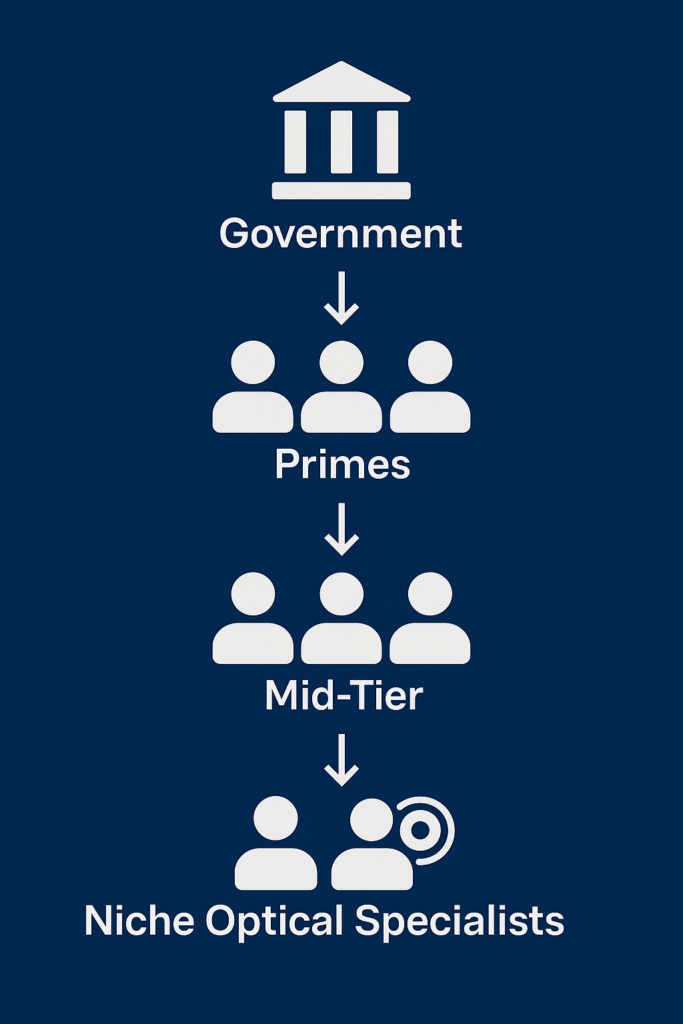
Satellite laser communications (satellite lasercom) and optical communications are transforming defense, intelligence, and space exploration missions. From secure high-capacity data relays to optical ground station backhaul, these technologies are advancing rapidly. Yet they depend on a vendor ecosystem that is smaller and more specialized than traditional RF or IT systems.
For U.S. government program managers (PMs), prime contractor BD leads, and technical SMEs, this creates a fundamental challenge: how do you find, vet, and compete among qualified suppliers in a niche domain?
Without rigorous market research and supplier vetting, programs risk:
– Vendor lock-in with a single prime or proprietary solution.
– Missed innovation from niche suppliers with breakthrough technologies.
– Performance shortfalls if immature vendors are awarded without sufficient evaluation.
The solution is proactive: effective market research methods, structured supplier vetting, and acquisition strategies that broaden competition.
2. Methods of Effective Market Research in Optical Communications
Effective market research requires going beyond a SAM.gov search. It combines government databases, industry engagement, standards bodies, and intelligence tools.
Government Sources:
- SAM.gov (https://sam.gov/)
- FPDS (https://www.fpds.gov/)
- GSA eLibrary (https://www.gsaelibrary.gsa.gov/)
- NASA SEWP (https://www.sewp.nasa.gov/)
Industry Engagement:
- Host industry days and technical interchange meetings.
- Use RFIs to gauge market maturity.
- Encourage one-on-one briefings with niche firms.
Standards & Consortia:
- CCSDS (https://public.ccsds.org/)
- IEEE (https://ieeexplore.ieee.org/)
- ITU (https://www.itu.int/en/ITU-T/)
Academic & Small Business Indicators:
- SBIR/STTR (https://www.sbir.gov/) awards highlight emerging capability.
- NASA/DARPA partnerships with universities.
Commercial Intelligence Tools:
- GovWin, Bloomberg Government, Jane’s.
- Patent/publication analytics.
The most effective strategy is triangulation: verify supplier capabilities across official data, standards engagement, and direct interactions.

3. Supplier Vetting in Specialized Optical Technology Domains
Identifying vendors is only half the battle. Programs must vet suppliers against mission-critical criteria.
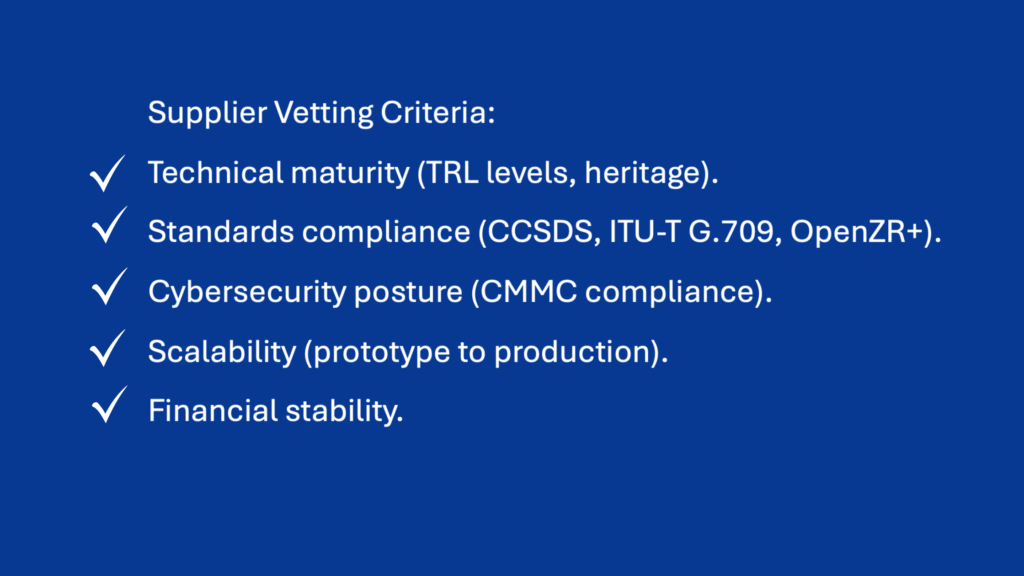
Key Supplier Vetting Criteria:
- Technical maturity (TRL levels, heritage).
- Standards compliance (CCSDS 141.10, ITU-T G.709, OpenZR+).
- Cybersecurity posture (CMMC compliance).
- Scalability (prototype to production).
- Financial stability.
Evaluation Methods:
- Site visits and factory acceptance testing.
- Independent quality audits (ISO, AS9100).
- Past performance reviews on NASA/DoD/IC contracts.
Role of SMEs:
Independent optical SMEs validate technical claims, confirming modulation, PAT, and coding approaches are realistic.
4. Challenges in Accessing a Broad Vendor Base for Satellite Lasercom
Even with robust research, PMs and acquisition teams face structural barriers to vendor access:
– Niche vendor pool (many <100 employees).
– Visibility gap (lack contracting staff).
– Acquisition inertia (default to primes).
– Vendor lock-in risk.
– Security/export controls (ITAR/EAR).
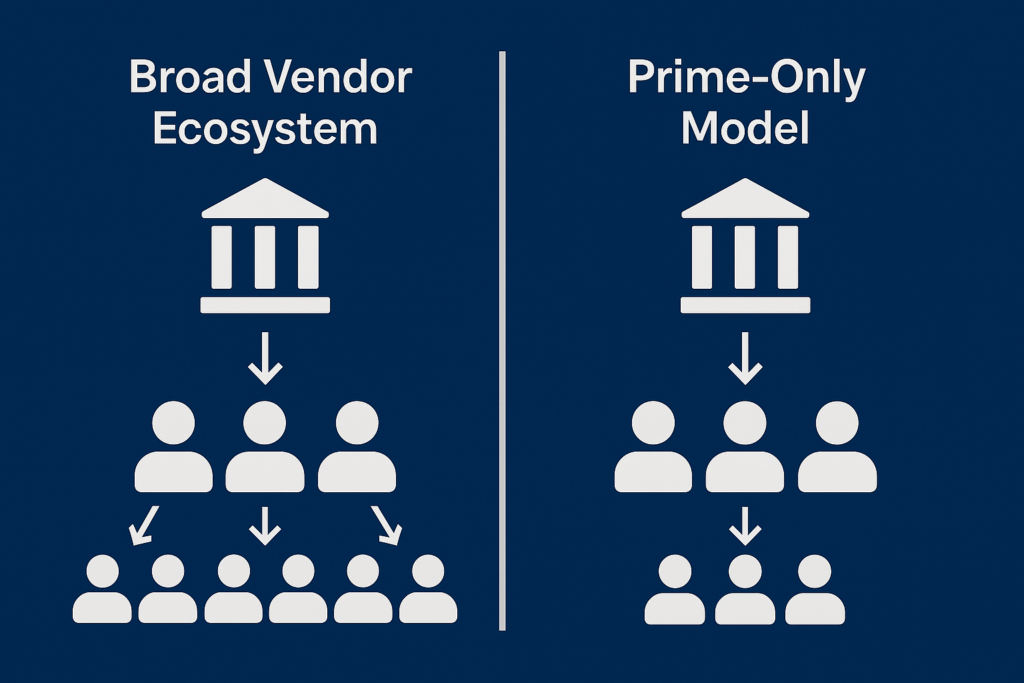
Result: fewer bidders, reduced competition, and higher risk.
5. Best Practices for Building Robust Competition in Optical Communications
To avoid vendor lock-in, acquisition must encourage diversity:
– Small Business Participation (set-asides, SBIR).
– Modular Architectures (split contracts into components).
– Pre-Qualification (IDIQs, BPAs, GWACs).
– Teaming Arrangements (primes + SMEs).
– Open Standards (CCSDS/ITU compliance).
Example RFP clause:
“The optical terminal shall comply with CCSDS 141.10 optical coding and ITU-T G.709 framing to ensure multi-vendor interoperability.”
6. Real-World Implications for DoD, NASA, and IC Programs
Case studies highlight vendor strategies:
– Success: NASA LCRD (https://www.nasa.gov/mission_pages/tdm/lcrd/) used modular design → greater vendor diversity.
– Challenge: DoD optical program (anonymized) → single vendor reliance → delays and cost growth.
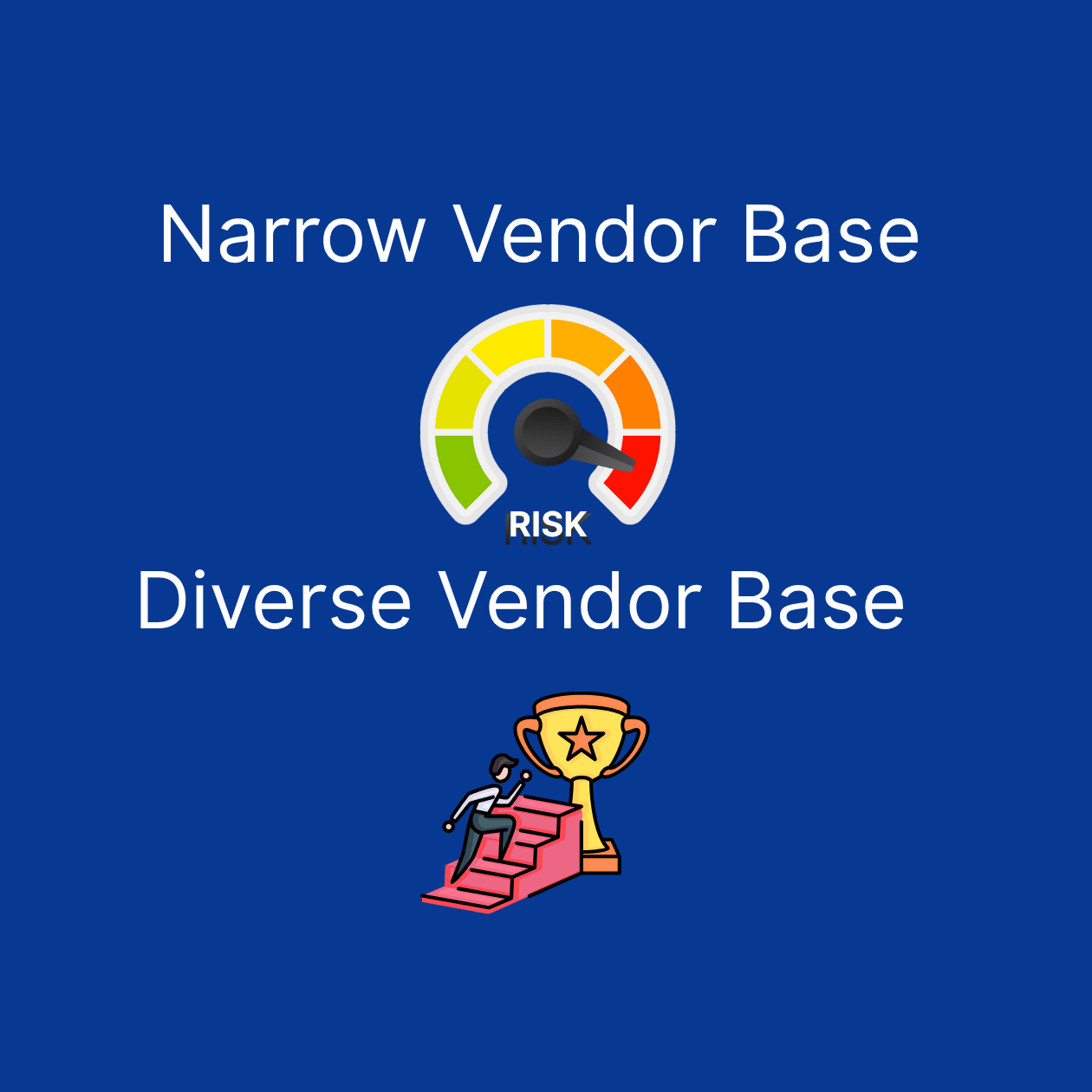
Lesson: Diverse supplier base = resilience. Narrow base = fragility.
7. Additional Topics Relevant to DoD/DNI Acquisition Teams
– Supply chain resilience.
– Export controls.
– International programs (ESA IRIS²: https://www.esa.int/Enabling_Support/Space_Transportation/IRIS2).
– AI/ML tools for vendor vetting.
– SME involvement in procurement.
8. Conclusion: Action Items for PMs and COs
Effective market research and supplier vetting are mission assurance tools.
Action Items:
- Define vetting criteria (TRL, standards, cybersecurity).
- Expand competition beyond primes.
- Leverage standards to ensure interoperability. Embed SMEs into procurement and evaluation.
Without these steps, programs risk higher costs and weaker performance.
9. Non-Traditional Acquisition Approaches: OTA and GSA Schedule
Traditional acquisition (FAR) is slow, costly, and difficult for non-traditional optical vendors. To address these challenges, the government increasingly uses non-traditional tools like Other Transaction Authority (OTA) and GSA Schedules. These reduce acquisition schedules, cut costs, and broaden access.
Motivation:
- Speed: FAR awards take 18–24 months; OTAs in weeks.
- Flexibility: OTAs allow tailored IP/data rights.
- Access to non-traditionals: many optical startups lack FAR compliance.
Competition: reduces reliance on primes.
How OTAs differ:
- Governed under 10 U.S.C. § 4022, not FAR.
- Used for research, prototyping, follow-on production.
- Flexible IP/cost-sharing terms.
- Limited protests, faster cycles.
Examples:
- SDA: used OTAs for optical crosslinks in proliferated LEO.
- DIU: used OTAs for commercial FSO prototyping. DARPA: OTAs for optical sensing and photonics.
GSA MAS:
- Pre-competed schedule, reduces admin burden.
- Vendors gain recurring access across agencies.
Takeaway: OTAs and GSA Schedules accelerate timelines and broaden vendor pools for optical comms.
10. Conclusion: Action Items for PMs and COs
Market research, supplier vetting, and non-traditional acquisition approaches are mission assurance activities.
Action Items:
- Define vetting criteria (TRL, standards, cybersecurity).
- Expand competition beyond large primes.
- Leverage open standards for interoperability.
- Embed SMEs into procurement.
- Use OTAs and GSA Schedules for speed and access.
For related insights on the importance of ground infrastructure, see: Optical Fiber Infrastructure for Ground Station Reliability.
Lightwave Analytics supports U.S. government and industry partners with advanced modeling, acquisition support, and technical analysis for optical communications — from satellite lasercom to terrestrial fiber networks.
We support government programs and industry teams with deep-domain expertise and mission-aligned insight.
📄 Download our capability statement