

1. Introduction: Power vs. BER Defines Optical Link Success
Satellite lasercom promises fiber-class throughput for government missions. But in optical links, success is not simply a matter of launching more photons. Instead, performance depends on the trade-off between transmit power and the bit error rate (BER) achieved for a given modulation format.
BER is the performance metric that matters most for acquisition teams. It defines whether a link can meet service-level agreements and determines how much margin must be built into designs.
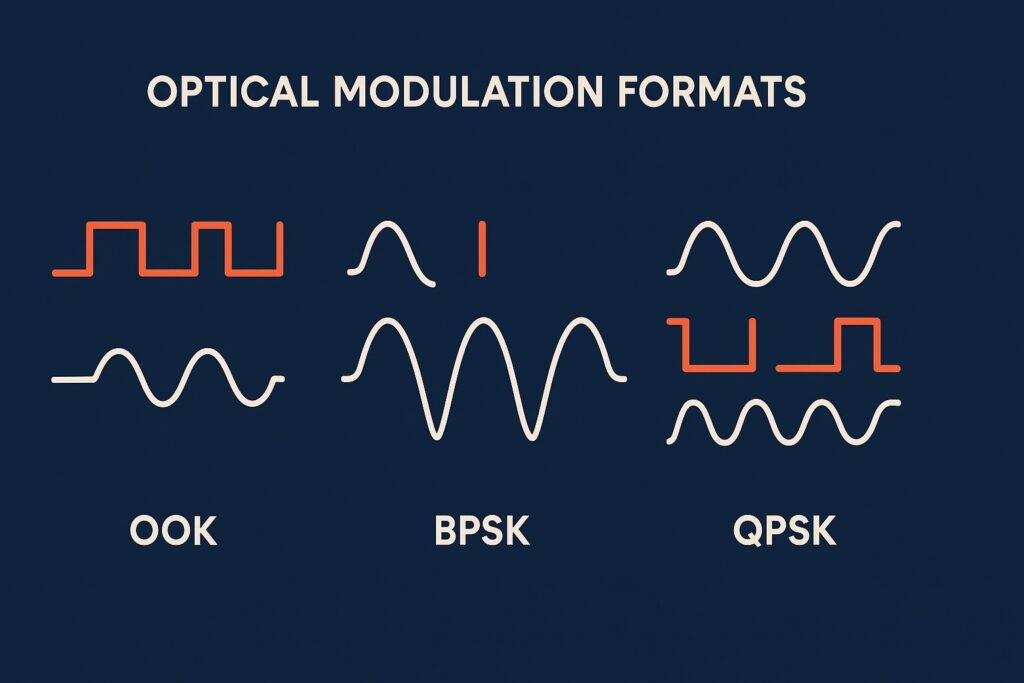
This blog explores power vs. BER trade-offs for OOK, BPSK, QPSK, and dual-polarization QPSK (DP-QPSK). It balances the needs of program managers — who must translate physics into clear requirements — and SMEs — who care about link models and equations. Along the way, we’ll review real-world programs (ESA SILEX, Alphasat, EDRS, IRIS², NASA LCRD, ILLUMA-T, Artemis) and offer acquisition guidance.
2. BER Basics: Power, SNR, and the Q-Function
Why BER Matters:
BER measures the fraction of bits received incorrectly. For high-rate optical downlinks, even a BER of 10⁻³ means thousands of errors per second at Gb/s speeds. Fortunately, forward error correction (FEC) can recover many of these — but only if raw BER is specified clearly in acquisition requirements.
The Q-Function Relationship:
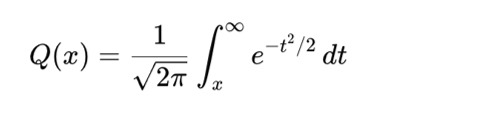
In Gaussian noise channels, BER can be written in terms of the Q-function:
For binary decisions:
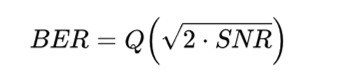
Plain English: The stronger the signal compared to noise (higher SNR), the less likely noise will flip a bit.
[Insert: BER vs. SNR chart showing steep drop-off with increasing SNR]
3. BER Models for OOK, BPSK, QPSK, and DP-QPSK
3.1 On-Off Keying (OOK) – Direct Detection:
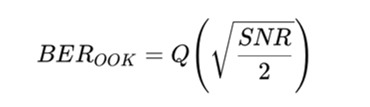
– Simple, low-cost.
– Poor power efficiency.
3.2 Binary Phase-Shift Keying (BPSK) – Coherent Detection:
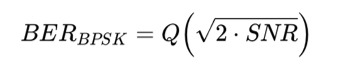
– Highly power efficient.
– Requires coherent receiver.
3.3 Quadrature Phase-Shift Keying (QPSK) – Coherent Detection:
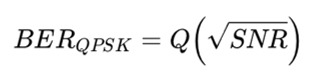
– Doubles spectral efficiency.
– Requires precise PAT.
3.4 Dual-Polarization QPSK (DP-QPSK) – Coherent, 4D Modulation:
– Two orthogonal polarizations, each carrying QPSK.
– Encodes 4 bits per symbol.
– Widely adopted in terrestrial fiber optics (100–400 Gb/s transport) (see ITU-T G.709 OTN: https://www.itu.int/rec/T-REC-G.709/en).
– Logical extension for Tb/s-class satellite lasercom systems.
Because DP-QPSK will play a major role in near-term 100Gb/s systems we’ll spend a bit more time discussing the details.
Dual-Polarization QPSK (DP-QPSK) is essentially two orthogonal polarizations (X and Y), each carrying a QPSK signal. That makes it a 4D modulation format with 16 possible constellation states (4 in X-pol × 4 in Y-pol).
Because the two polarizations are independent, the bit error rate (BER) of DP-QPSK is the same as QPSK on each polarization, but with double the throughput
BER Formula for DP-QPSK (per bit)
Since DP-QPSK carries two independent QPSK streams, the BER per bit is:
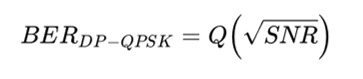
The form is identical to QPSK. What changes is the spectral efficiency (bits/symbol), not the raw BER expression.
- QPSK: 2 bits/symbol
- DP-QPSK: 4 bits/symbol (2 × QPSK on orthogonal polarizations)
Plain English for PMs/COs
- DP-QPSK doesn’t improve the BER curve versus QPSK.
- Its advantage is doubling capacity without increasing bandwidth, by using both polarizations.
- At the same SNR, DP-QPSK achieves the same BER per bit as QPSK, but transmits twice the data rate.
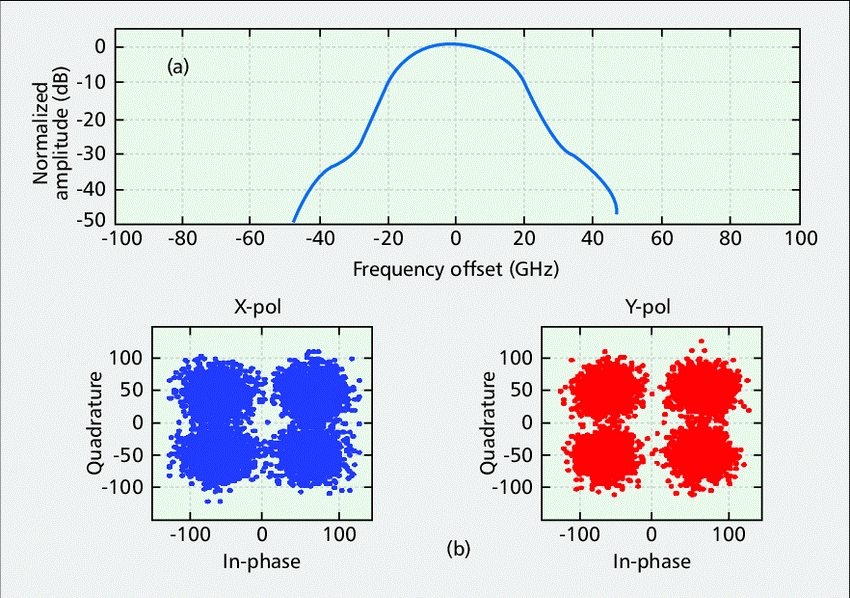
👉 For acquisition requirements: if a program specifies BER ≤ 10⁻² pre-FEC at SNR = X, this applies equally to QPSK and DP-QPSK. The difference is that DP-QPSK delivers 2× throughput for the same BER target.
4. Interpreting BER Thresholds in Acquisitions
Why Different Formats Use Different BER Targets:
- OOK: often requires BER ≤10⁻³ pre-FEC.
- BPSK/QPSK: thresholds around 10⁻² are acceptable, relying on FEC standards like OpenZR+ (https://openzrplus.org/), CCSDS 141.10 Optical Coding (https://public.ccsds.org/Pubs/141x10g3.pdf), ITU-T G.975.1 (https://www.itu.int/rec/T-REC-G.975.1/en), and ITU-T G.709 OTN (https://www.itu.int/rec/T-REC-G.709/en).
Plain English: tie BER requirements to FEC standards, not raw BER numbers.
5. Real-World Programs: Lessons Learned
ESA SILEX (2001): https://www.esa.int/Enabling_Support/Operations/SILEX
– 50 Mbps, OOK-based. Proved feasibility but required high margins.
ESA Alphasat (2013): https://www.esa.int/Applications/Telecommunications_Integrated_Applications/Alphasat
– GEO-to-ground >1 Gb/s with beacon-assisted PAT.
ESA EDRS (2016–ongoing): https://www.esa.int/Applications/Telecommunications_Integrated_Applications/EDRS
– GEO relay backbone using BPSK/QPSK.
ESA IRIS² (planned): https://www.esa.int/Enabling_Support/Space_Transportation/IRIS2
NASA LCRD (2021–ongoing): https://www.nasa.gov/mission_pages/tdm/lcrd/
NASA ILLUMA-T (2024): https://www.nasa.gov/mission_pages/station/research/experiments/explorer/Facility.html#id=7530
NASA Artemis Lunar Relay (planned): https://www.nasa.gov/artemis/
Lesson: coherent BPSK/QPSK with beacon-assisted PAT are viable at scale; DP-QPSK likely to follow.
6. Acquisition Implications: What PMs Need to Specify
Introduction:
PMs must turn physics into contract-ready language.
Key Requirements:
- BER thresholds tied to standards (ITU-T G.975.1: https://www.itu.int/rec/T-REC-G.975.1/en, ITU-T G.709 OTN: https://www.itu.int/rec/T-REC-G.709/en, OpenZR+: https://openzrplus.org/).
- Transmit power budgets with explicit margins.
- PAT method selection: beacon-assisted PAT + fine steering mirrors (FSMs) have shown best operational performance.
- Acquisition/reacquisition times (<10s with ≥95% probability).
- Environmental modeling (Cn² turbulence, jitter).
7. Beyond BER: Availability and Fade Margins
Introduction:
Atmosphere distorts uplink and downlink signals, causing scintillation and fading.
Scintillation Variance (Rytov):
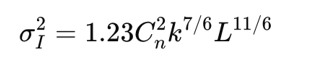
– Stronger turbulence, longer paths, shorter wavelengths = more fluctuations.
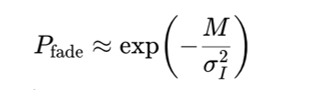
Fade Probability:
8. Real-World Implications
For SMEs:
– OOK = simple but inefficient.
– BPSK/QPSK = proven, scalable.
– DP-QPSK = future of Tb/s-class relays.
For PMs/COs:
– Tie BER to FEC standards (ITU-T G.975.1, ITU-T G.709, OpenZR+).
– Specify PAT methods explicitly (beacon-assisted + FSM).
– Require environmental models.
See also: Optical Fiber Infrastructure for Ground Station Reliability.
9. Conclusion: Power, BER, and Acquisition Discipline
Every optical communications program must answer: how much power is enough to guarantee mission-ready BER?
Key Takeaways:
– OOK = simple but power-hungry.
– BPSK/QPSK = efficient, operational.
– DP-QPSK = terrestrial standard moving into space.
– ITU-T G.975.1 and G.709 define realistic BER thresholds.
– Beacon-assisted PAT + FSM = best operational PAT.
– RFPs must allocate jitter budgets and specify reacquisition.
Call to Action
Defining modulation trade-offs in acquisition is complex — but it’s the difference between mission assurance and missed targets.
Lightwave Analytics supports U.S. government and industry partners with advanced modeling, acquisition support, and technical analysis for optical communications — from satellite lasercom to terrestrial fiber networks.
We support government programs and industry teams with deep-domain expertise and mission-aligned insight.
📄 Download our capability statement.