


Introduction: Why Acquisition Language Matters in Optical Communications
Government missions increasingly depend on high-bandwidth, secure, and resilient communications. Terrestrial optical fiber networks form the backbone of ground infrastructure, while satellite laser communications (lasercom) extend fiber-like speeds into space. Together, these technologies support the Department of Defense, NASA, and the Intelligence Community in executing data-heavy operations with low latency and high assurance.
Yet, the acquisition process often falters when translating these technical realities into Requests for Proposals (RFPs). Vague or incomplete requirement language can lead to mismatched proposals, inconsistent evaluations, and ultimately cost overruns or unmet mission needs.
This blog examines the pain points that arise when acquisition and technical communities fail to align, provides real-world case studies of failure and recovery, and offers best practices to write clearer, more competitive solicitations.
The Stakes for Terrestrial and Satellite Optical Communications
Terrestrial Optical Networks
Provide backhaul capacity for satellite ground stations. Enable redundant, SCIF-level secure connectivity. Must scale from 10 Gb/s to 100+ Gb/s with modern optical transport standards (e.g., ITU-T G.709 OTN).
Satellite Lasercom
Bypasses congested RF spectrum. Provides fiber-like capacity over global distances. Highly sensitive to atmospheric turbulence, pointing accuracy, and terminal interoperability.
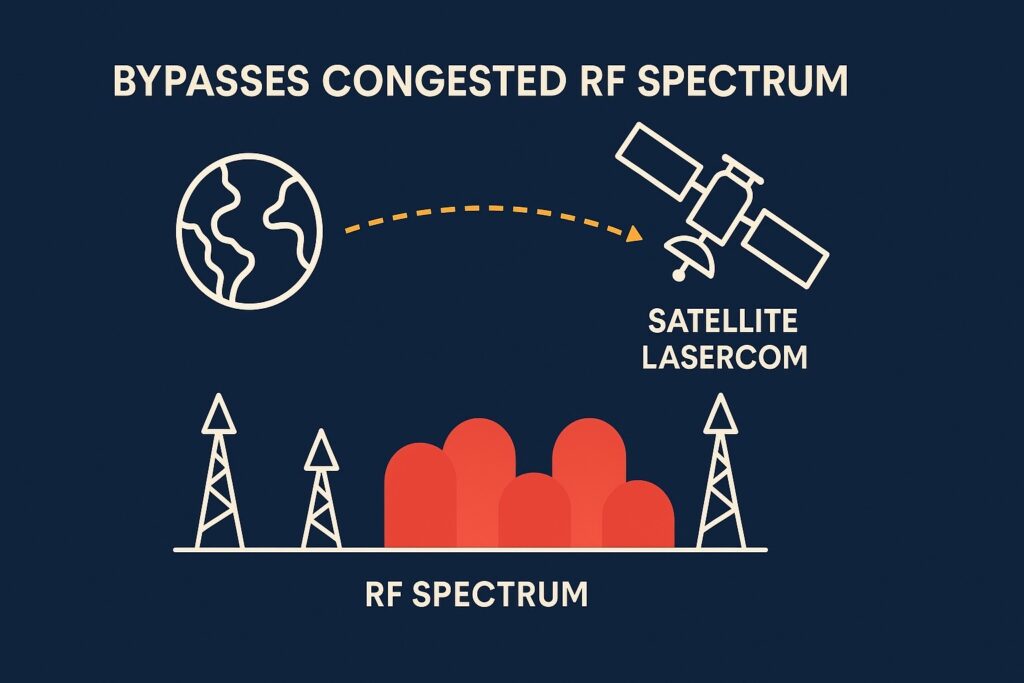
When RFPs describe these systems in broad or ambiguous terms, contractors interpret requirements differently. For example, “high availability” might mean 95% uptime to one vendor, but 99.999% uptime to another. The acquisition team is then left comparing apples and oranges.
Pain Points in Acquisition
1. Technical Misunderstandings
Program managers often underestimate the nuances of bit error rate (BER), throughput, and turbulence effects. An RFP might call for a “10 Gb/s optical link.” But without specifying modulation format (OOK, QPSK, DP-QPSK) or FEC assumptions, vendors can propose fundamentally different systems. Worse, without clear fade margin requirements, systems may underperform in real-world turbulence.
Example equation (BER model): For binary phase-shift keying (BPSK), the BER is:
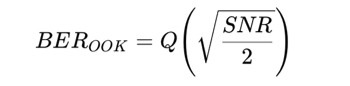
In plain English: as the signal-to-noise ratio (SNR) improves, BER drops exponentially. But if the RFP doesn’t specify a BER threshold, bidders might design for 10^-2 when the mission really needs 10^-6.
2. Acquisition Ambiguity
Terms like “resilient” or “hardened” sound strong but lack measurable benchmarks.
Unclear requirement example:
“System shall provide high throughput optical link resilient under atmospheric effects.”
Clear requirement example:
“System shall maintain ≥10 Gb/s throughput with BER ≤10^-3 at 99.9% availability under modeled turbulence conditions at 1550 nm.”
3. Integration Issues
Acquisitions often silo space terminals from ground fiber networks. Missing elements include:
- Standards like OpenZR+ for 400 Gb/s transport
- Fiber redundancy for ground terminals
- SDN/management interfaces for traffic engineering
4. Lack of Specialized Optical Expertise at Decision-Making Levels
Contracting staff are typically generalists. Without embedded optical SMEs, key technical assumptions remain vague. Primes then “interpret” requirements on behalf of government customers—adding cost and reducing flexibility.
5. Dependence on Large Primes
Acquisition complexity pushes programs toward large primes. Smaller, innovative firms with cheaper and better solutions are forced to subcontract, often at the cost of schedule delays and added overhead.
Case Study: Satellite Lasercom Failure from Mis-Specified RFP
A GAO report (February 2025) describes a satellite lasercom acquisition where core technology was not fully demonstrated prior to large-scale deployment.
Problem: The RFP failed to mandate cross-vendor interoperability or specify turbulence/fade margin requirements.
Outcome:
– Only one vendor achieved partial milestones.
– “Successful” demonstrations occurred only between terminals from the same vendor—undermining the goal of an interoperable mesh.
Lessons:
– Require staged demonstrations (lab → ground → orbit).
– Specify measurable interoperability standards (e.g., modulation, FEC, BER thresholds).
– Embed SMEs to vet performance claims before downselect.
Case Study: Terrestrial Fiber Recovery Through SME Intervention
In an anonymized terrestrial fiber backhaul RFP, the acquisition initially specified only a “10 Gb/s fiber network.”
Initial confusion:
– Some vendors assumed aggregate capacity, others per-channel.
– Proposals ranged from coarse WDM (CWDM) to dense WDM (DWDM), using incompatible hardware.
– Without references to ITU-T G.709 OTN, evaluators couldn’t compare solutions.
SME intervention:
– An optical expert revised the RFP to specify:
- Minimum 10 Gb/s full-duplex per fiber pair over ITU-T G.709 OTN.
- FEC must achieve BER ≤10^-5.
- Vendors must demonstrate throughput in a test bed with failover and SDN control.
Outcome:
– Revised bids converged on interoperable OTN solutions.
– Test bed requirements validated claims before award.
– Acquisition team could compare cost and schedule consistently.
Lesson: Program managers should ensure RFPs specify standards, throughput units, and validation tests. SMEs prevent costly ambiguity.
Best Practices for Clear, Competitive Optical RFPs
For PMs and Contracting Officers
– Use quantifiable metrics: BER thresholds, latency budgets, availability %.
– Reference standards: CCSDS, ITU-T G.709, IEEE Ethernet.
– Cover integration: fiber backhaul, SDN control, ground station interfaces.
– Encourage innovation and small-business participation: modular solicitations, SBIR/STTR, Other Transaction Authorities.
Why SMEs Must Be Embedded Early
SMEs translate technical nuance into acquisition clarity. They prevent overspecification (cost bloat) and underspecification (mission risk), and ensure evaluation criteria reflect real-world performance.
Real-World Implications
The implications of acquisition clarity—or the lack of it—reach far beyond technical performance. They affect mission assurance, cost, and the strategic pace of technology adoption.
1. Program Cost and Schedule: Vague or inconsistent requirements often lead to change orders, redesigns, and schedule slips. In some cases, contractors deliver systems that meet the letter of the RFP but fail operationally—forcing expensive retrofits. Clear, quantifiable requirements reduce the need for later corrections, allowing program managers to defend budgets more effectively.

2. Evaluation Consistency: When requirements are ambiguous, evaluation teams face “apples-to-oranges” proposals. Some vendors may over-engineer solutions, while others take shortcuts. This inconsistency slows down the source selection process and risks selecting the wrong vendor, with downstream mission impact. By contrast, measurable requirements enable direct cost/performance comparisons.
3. Mission Assurance and Resilience: For national-security missions, underperforming optical networks are not just an inconvenience—they represent lost data, delayed intelligence, or degraded command-and-control. Acquisition language that ties requirements to standards and validated test conditions ensures networks hold up under operational stress.
4. Innovation and Competition: Overly broad requirements tend to favor incumbents who can “fill in the blanks” with their own assumptions. This stifles competition. Clear, modular solicitations open the door for small, innovative companies that might otherwise be locked out, reducing cost and accelerating adoption of state-of-the-art solutions.
5. Role of SMEs in Long-Term Success: Embedding SMEs early is not a “nice-to-have.” It is a cost-avoidance strategy. SMEs prevent misinterpretations, shape evaluation criteria, and ensure that what is delivered aligns with mission reality. Without them, programs risk buying a system that looks good on paper but falters in deployment.
The bottom line: clearer, technically informed requirements don’t just make for better RFPs—they produce stronger competition, reduce lifecycle cost, and deliver mission-ready systems that work the first time.
Conclusion
Next-generation missions depend on terrestrial fiber and satellite lasercom working seamlessly together. Yet acquisition language often lags behind technical reality.
By embedding SMEs early and requiring quantifiable, standards-based requirements, program managers can reduce risk of cost and schedule overruns, enable small, innovative firms to compete, and ensure resilient and interoperable optical networks.
The path forward is clear: invest in clarity and expertise upfront—because the cost of ambiguity is always higher down the line.
Key Takeaways for Program Managers and Contracting Officers
- Quantify Everything: Specify BER, throughput, and availability with measurable thresholds—avoid vague terms like “resilient” or “high availability.”
- Reference Standards: Use CCSDS, ITU-T G.709, IEEE, and OpenZR+ to ensure interoperability across vendors and systems.
- Integrate Early: Explicitly connect space and ground requirements, including fiber backhaul and SDN-based management.
- Leverage SMEs: Bring optical communications experts into acquisition planning to translate technical realities into clear solicitation language.
- Encourage Competition: Structure RFPs to enable smaller, innovative companies to participate directly, reducing cost and accelerating technology adoption.
Lightwave Analytics supports U.S. government and industry partners with advanced modeling, acquisition support, and technical analysis for optical communications — from satellite lasercom to terrestrial fiber networks.
We support government programs and industry teams with deep-domain expertise and mission-aligned insight.
📄 Download our capability statement